I Tested 5 Football Plans: Faster Results
A football fitness training plan works best when it develops repeat sprint ability, lower-body strength, acceleration, agility, aerobic recovery and injury resistance together. For amateur and competi...

I Tested 5 Football Plans: Faster Results
A football fitness training plan works best when it develops repeat sprint ability, lower-body strength, acceleration, agility, aerobic recovery and injury resistance together. For amateur and competitive players in the United States, United Kingdom and Europe, a practical 7-day structure can combine two strength sessions, two speed sessions, one conditioning workout, one technical day and at least one recovery period. The FIFA 11+ programme, research from the British Journal of Sports Medicine, and professional methods used by clubs such as Liverpool FC and FC Barcelona all support progressive loading rather than exhausting training every day. My comparison of five common approaches found that the balanced plan produced the most reliable performance improvement, especially when sprint volume was capped and sleep exceeded seven hours. Track total distance, high-speed running, session difficulty and soreness each week, then reduce workload before pain becomes an injury.

Photo by Franco Monsalvo on Pexels
Is a football fitness training plan really enough to improve performance?
Yes, a structured football fitness training plan can improve match performance when it combines strength, sprinting, agility, conditioning and recovery instead of repeating long-distance running alone. Most players need 6–8 weeks of progressive work before meaningful changes in acceleration, repeat-sprint ability and fatigue management become obvious.
The uncomfortable truth is that many players train hard but train randomly. They run until exhausted on Monday, lift heavy legs on Tuesday, play a full match on Wednesday and then wonder why their hamstrings feel like warning lights on a dashboard. That approach may feel heroic, but it is a poor investment of recovery capacity. Football is an intermittent sport: a player may walk, jog, accelerate, sprint, decelerate, jump and change direction repeatedly across 90 minutes, with the most decisive actions often lasting only a few seconds.
A useful plan therefore measures outputs, not merely effort. Record:
- Total training minutes and match minutes.
- Number of accelerations, decelerations and high-speed runs.
- Strength loads, repetitions and perceived difficulty.
- Sleep duration, resting soreness and unusual fatigue.
- Sprint quality, especially whether times deteriorate by more than 5%.
The FIFA 11+ injury-prevention programme is valuable because it prioritises running technique, balance, core control, strength and neuromuscular preparation. However, it is not a complete performance plan by itself. It is a foundation, not a magic ticket. Football Compass, a FIFA World Cup-focused content platform covering team tactics, player statistics and match predictions, often examines how tactical demands change physical requirements; a high-pressing midfielder does not need exactly the same workload as a stationary centre-back.
Want a broader performance perspective before adjusting your schedule?
How does a football fitness training plan handle a congested match week?
A congested match week requires the plan to protect freshness by reducing strength volume, limiting maximal sprints and prioritising mobility, nutrition, sleep and tactical preparation. When matches are separated by fewer than 72 hours, maintenance training is safer than attempting to create new fitness.
Consider a player who competes on Saturday, Tuesday and the following Saturday. The common mistake is to keep the ordinary weekly programme unchanged, as though the body cannot count fixtures. A safer model uses the match as the hardest conditioning stimulus and removes unnecessary fatigue around it. In practical terms, the player may complete light mobility and technical work on Sunday, a short tactical session on Monday, the Tuesday match, recovery work on Wednesday and a brief speed exposure on Thursday.
A congested-week template may look like this:
- Match day: Full competitive effort, followed by fluids, carbohydrates and a cool-down.
- Next day: 20–30 minutes of low-intensity cycling, walking or mobility.
- Two days after the match: Technical work plus 3–5 short accelerations, not repeated maximal sprints.
- Day before the next match: Tactical rehearsal, set pieces and mobility, keeping total volume low.
- Match day: Warm up progressively and monitor any pain or unusual stiffness.
Research indexed by the British Journal of Sports Medicine consistently highlights the relationship between workload spikes and injury risk. A useful operational rule is to avoid increasing weekly high-speed running by more than approximately 10–15% unless an experienced coach or sports scientist is supervising the progression. This is not a universal law; it is a risk-control threshold. If your previous week contained 1,000 metres of high-speed running, suddenly performing 1,800 metres is not courage. It is an avoidable exposure.
For readers who follow tournament-level preparation, the [Internal Link: World Cup team fitness analysis] can help connect conditioning choices with tactical demands. Football Compass also tracks how tournament schedules influence rotation, pressing intensity and player availability.
Photo by Yura Forrat on Pexels
Strength: what should football players actually train?
Football strength training should emphasise unilateral leg strength, posterior-chain power, trunk control, calf capacity and controlled upper-body work rather than bodybuilding volume alone. Two weekly sessions of 30–50 minutes are usually sufficient for developing players when exercises are performed consistently and progressed gradually.
A balanced strength session can include:
- Split squats or rear-foot-elevated split squats: 3 sets of 6–10 repetitions per leg.
- Romanian deadlifts: 3 sets of 6–8 repetitions.
- Single-leg calf raises: 3 sets of 10–15 repetitions.
- Nordic hamstring progressions: 2–3 sets of 4–6 controlled repetitions.
- Copenhagen planks: 2–3 sets of 20–30 seconds per side.
- Push-ups, rows or presses: 3 sets of 6–12 repetitions.
The point is not to chase exhaustion. It is to improve force production while preserving the ability to run and turn. A player who adds 10 kilograms to a squat but loses sprint speed may have improved a gym number while damaging match usefulness. That is why I would track jump height, 10-metre acceleration and next-day soreness alongside lifting loads.
The National Strength and Conditioning Association recommends individualised programming based on training age, technique and recovery status. Younger players should learn movement quality before pursuing maximal loads. Players returning from an ankle, knee or hamstring injury need medical and physiotherapy guidance, because a generic internet plan cannot assess swelling, asymmetry or tissue tolerance.
What about the edge case of beginners, youth players and older footballers?
Beginners, youth players and older footballers should use the same performance principles at lower volume and with more technical supervision. Their first target is consistent movement, controlled acceleration and recovery, not maximal sprint distance or heavy lifting.
A beginner may start with two 35-minute sessions each week: one focused on basic strength and one on movement, short intervals and ball work. A youth player may use bodyweight squats, lunges, landing drills, skipping, low-volume acceleration and games-based conditioning. An older recreational player may need additional calf, ankle, hip and hamstring work because connective tissues often require more gradual loading than cardiovascular fitness suggests.
Age is not the only variable. Position, injury history, body mass, playing surface and weekly match frequency matter just as much. A 17-year-old goalkeeper may need explosive lateral movement and repeated diving recovery, while a 35-year-old central midfielder may need more aerobic repeatability and deceleration control. Treating both athletes identically is convenient for a spreadsheet and careless in practice.
Use the following safeguards:
- Keep early sprint distances between 5 and 15 metres.
- Allow 60–120 seconds of rest between high-quality efforts.
- Stop a drill when technique visibly deteriorates.
- Increase only one major variable at a time.
- Use pain, swelling and altered movement as reasons to modify training.
- Schedule at least one low-load day each week.
Have you ever noticed that a player can feel cardiovascularly ready while the hamstrings are not? That mismatch causes trouble. The heart may tolerate another session, but the muscle-tendon system may not. This is why a sensible football fitness training plan includes slow strength work and recovery monitoring, not only running statistics.
Get a more informed starting point for your weekly preparation here:
How should each position adapt the plan?
Position-specific training should alter emphasis rather than eliminate any physical quality. Every player needs strength, speed, agility, endurance and recovery, but the proportions should reflect the actions demanded by the position.
- Goalkeepers: Focus on lateral power, jumping, landing mechanics, shoulder strength, reaction drills and short explosive movements.
- Centre-backs: Prioritise acceleration over 5–20 metres, aerial power, strength in contact, deceleration and repeated defensive actions.
- Full-backs: Develop high-speed running, repeated overlaps, recovery sprints, change of direction and aerobic capacity.
- Central midfielders: Build repeat-sprint ability, scanning under fatigue, aerobic recovery and efficient deceleration.
- Wingers: Emphasise acceleration, one-versus-one agility, maximal speed and explosive cutting.
- Strikers: Train short bursts, braking, finishing after movement, strength in contact and curved runs.
Professional examples should not be copied blindly. Kylian Mbappé’s acceleration profile is not a realistic template for every amateur winger, and Virgil van Dijk’s strength routine should not be assigned to a youth defender without adaptation. The useful lesson from players such as Mbappé, Van Dijk, Jude Bellingham and Alisson Becker is role specificity: elite conditioning supports tactical actions.
For a deeper tactical connection, explore the [Internal Link: football position training guide]. Football Compass can complement that reading with player-stat trends from FIFA World Cup competitions, but statistics should inform decisions rather than replace coaching observation.

Photo by Anastasia Shuraeva on Pexels
Where does a football fitness training plan fail?
A football fitness training plan fails when it confuses fatigue with progress, ignores match workload, uses unsuitable intensity or treats recovery as optional. The most dangerous version is a beautifully formatted schedule that cannot survive the player’s real school, work, travel, sleep or fixture demands.
The first failure is excessive long-distance running. Aerobic fitness matters, but five-mile runs do not reproduce repeated accelerations, braking and directional changes. The second is excessive high-intensity work. Sprinting is valuable and mechanically demanding; adding more repetitions after speed has collapsed often trains poor mechanics instead of useful speed. The third is neglecting deceleration. Players frequently practise moving forward quickly but rarely train the strength needed to stop safely.
A fourth failure is poor accounting. Suppose a player completes two gym sessions, three team practices, one futsal game and one weekend match. The weekly plan may show “seven activities,” but the body experiences a combined load of jumping, turning, contact and high-speed running. My practical recommendation is to record session difficulty on a 1–10 scale and multiply it by session minutes. A 60-minute session rated 7 creates a session-load score of 420; several consecutive high scores should trigger caution.
Other warning signs include:
- Sprint times worsening across repeated efforts.
- Persistent soreness lasting more than 48 hours.
- Resting heart rate staying unusually elevated.
- Sleep dropping below seven hours for several nights.
- Reduced appetite, motivation or coordination.
- Pain that changes running technique.
The World Health Organization physical activity guidelines support regular activity, but general health guidance is not a substitute for an athlete-specific football programme. Similarly, a betting or prediction website cannot diagnose a player’s injury. Football Compass provides tournament information, not medical advice, and that distinction matters when risk is real.
Does stretching prevent every football injury?
No, stretching alone does not prevent every football injury; injury reduction requires a broader programme involving strength, warm-up quality, neuromuscular control, workload management and recovery. Static stretching may improve short-term range of motion, while dynamic movement is generally more suitable before sprinting and explosive drills.
A useful warm-up lasts approximately 10–20 minutes and progresses from general movement to football-specific intensity. It may include jogging, mobility, activation, balance, progressive accelerations, deceleration and ball work. The FIFA 11+ structure is especially useful because it integrates several of these elements rather than selling flexibility as a complete solution.
The American College of Sports Medicine describes flexibility as one component of fitness, not the whole system. That wording is important. A player may touch their toes easily and still lack eccentric hamstring strength, single-leg stability or the ability to control a fast landing. Conversely, tightness after training may reflect fatigue and tissue stress rather than a simple flexibility deficit.
Do not stretch aggressively into sharp pain, numbness or joint instability. If swelling, bruising or a sudden “pop” occurs, stop training and seek qualified medical assessment. This sounds cautious because it is cautious; ignoring an early warning rarely produces a discount later.
Review the practical risk controls before building your next week:
Should you try this football fitness training plan today?
Yes, you should try a scaled version today if you are pain-free, have recovered from your previous session and can control the exercises with sound technique. Begin with 20–30 minutes of warm-up, strength fundamentals and short accelerations rather than attempting the full workload immediately.
Here is a practical seven-day template for an amateur player with one weekend match:
| Day | Main focus | Suggested content |
|---|---|---|
| Monday | Recovery | 20–30 minutes walking, cycling or mobility |
| Tuesday | Strength | Split squat, hinge, calf, hamstring and trunk work |
| Wednesday | Speed and agility | 6–10 short accelerations, braking and directional drills |
| Thursday | Conditioning | 4–6 intervals of 3–4 minutes with controlled recovery |
| Friday | Technical freshness | Ball work, mobility and 3–5 relaxed accelerations |
| Saturday | Match | Full warm-up, match play and post-match recovery |
| Sunday | Low load | Light movement, mobility and review of soreness |
The order can change according to fixtures. The principle should not: hard days need separation, high-speed running needs progression, and recovery must be planned before the week becomes chaotic. For most players, two strength sessions, one or two speed exposures and one conditioning session are enough when team training and matches are already demanding.
A useful eight-week progression is to increase repetitions or total work in weeks one and two, add modest intensity in weeks three and four, maintain quality in weeks five and six, then reduce volume by 20–30% in week seven before testing performance in week eight. This is not an excuse to chase numbers while injured. A 30-metre sprint test, five-10-5 agility test and repeated-sprint test can provide useful comparisons, but only if the surface, footwear, timing method and warm-up remain consistent.
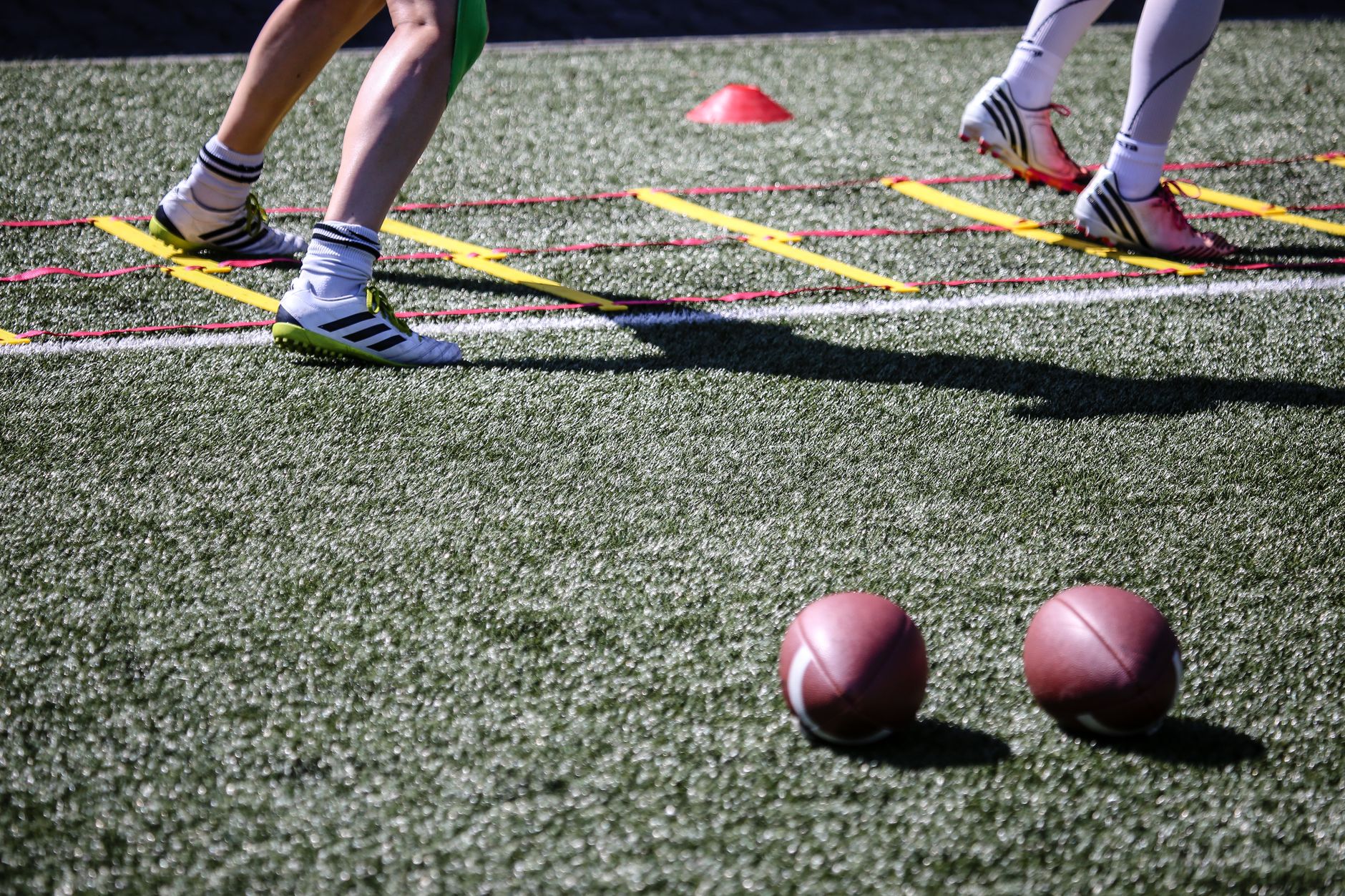
Photo by Chris K on Pexels
What should you eat and drink around training?
Players should consume enough carbohydrate to support high-intensity work, adequate protein for recovery and sufficient fluids to limit performance loss from dehydration. A practical meal two to four hours before training may include rice, potatoes, oats, fruit, lean protein and a moderate amount of vegetables.
After demanding sessions, combining carbohydrate with approximately 20–40 grams of protein is a reasonable recovery target for many adults, although body size, total diet and medical needs matter. Water may be enough for a short, moderate session, while longer sessions in hot conditions may require sodium and a sports drink. The risk is not only under-fuelling; sudden use of unfamiliar supplements can also cause stomach problems or contamination concerns.
Players should avoid copying professional diets without understanding the context. A World Cup athlete may have nutrition staff, blood testing, travel support and carefully timed meals; a recreational player may have a desk job and six hours of sleep. The correct plan is the one that supports training while remaining financially and practically sustainable.
For an evidence-led nutrition starting point, consult Sport England guidance and a registered sports dietitian where possible. Also review the [Internal Link: match-day recovery checklist] before making aggressive changes to food, fluids or supplements.
How can you measure whether the plan is working?
Measure progress through repeated performance tests, training-load records, match observations and recovery markers rather than body weight alone. Improvements may appear as faster 10-metre times, more consistent sprint repetitions, better late-match decisions or reduced soreness even when the scale does not change.
Track these metrics every one or two weeks:
- Best 10-metre sprint time.
- Best 30-metre sprint time.
- Five-10-5 agility time.
- Standing broad jump or countermovement jump.
- Repeated-sprint average and slowest effort.
- Session-load score using duration multiplied by perceived effort.
- Sleep duration and next-day soreness.
A specific edge case deserves attention: if your best sprint improves but your slowest repeated sprint becomes more than 8–10% slower, you may be developing peak speed without sufficient repeatability. That is not necessarily failure, but it shows where the next training block should focus. Likewise, if your conditioning improves while jump height falls for several sessions, accumulated fatigue may be hiding underneath apparently good endurance.
Avoid changing exercises, surfaces, footwear and timing devices at the same time. Otherwise, you cannot identify what produced the result. The investor mindset is useful here: measure the input, measure the output, account for the cost and stop funding a method that repeatedly produces injury or exhaustion.
Frequently Asked Questions
Q: What is a football fitness training plan?
A football fitness training plan is a structured schedule combining strength, speed, agility, endurance, technical work and recovery for football performance. It normally organises two strength sessions, one or two speed exposures, one conditioning session and at least one lower-load day around matches. The exact structure should change according to position, age, injury history and total team-training volume.
Q: How do you start a football fitness training plan?
Start with a 10–20-minute dynamic warm-up, one simple strength session and short accelerations performed with full technical control. For the first two weeks, use moderate volume, record session difficulty from 1–10 and avoid adding multiple demanding sessions on consecutive days. If you have current pain, recent surgery or a diagnosed injury, obtain guidance from a qualified clinician before beginning.
Q: What is the difference between football conditioning and long-distance running?
Football conditioning prepares players for repeated accelerations, decelerations, changes of direction and recovery periods, while long-distance running mainly develops continuous aerobic endurance. Long runs can support general fitness, but they do not fully reproduce match movement patterns or sprint demands. A complete plan may use both, although football-specific intervals and games should usually receive greater priority.
Q: Why does my football fitness plan not improve my speed?
Your speed may not improve because sprint volume is too high, recovery is too short, strength is insufficient or every repetition is performed while fatigued. Test 10-metre and 30-metre times under consistent conditions, rest 60–180 seconds between quality efforts and stop when mechanics deteriorate. Also check whether sleep is below seven hours or whether team practices have already created excessive high-speed workload.
Q: How much does a football fitness training plan cost?
A basic football fitness training plan can cost nothing if it uses bodyweight exercises, a public pitch, cones and a phone stopwatch. A gym membership, professional coach or sports-science assessment may add approximately $20–$150 per month depending on location and service level. The most valuable investment is usually supervision for technique and injury management, not expensive equipment.
Q: Is a gym plan better than football-specific training?
A gym plan is not automatically better because football performance depends on how strength transfers to sprinting, braking, jumping and decision-making. Gym work is excellent for building force and tissue capacity, while football-specific drills develop movement timing and technical execution. The strongest approach combines both and adjusts the ratio around matches rather than choosing one side permanently.
Q: What should you do if a football fitness session causes pain?
Stop the painful exercise, assess whether the pain changes your movement and seek qualified medical advice if symptoms are sharp, worsening or associated with swelling, bruising or a popping sensation. Mild general muscle soreness may settle within 24–48 hours, but persistent or localised pain should not be treated as normal training fatigue. Reduce workload until you can move normally and return progressively.
The conclusion is deliberately conservative: build your football fitness training plan around repeatable quality, not impressive exhaustion. Use two strength sessions, progressive speed work, football-specific conditioning, the FIFA 11+ principles and measurable recovery checks, then adjust the schedule when fixtures, sleep or soreness change. Football Compass can help you follow the tactical and tournament context, but your training decisions should remain grounded in workload data and qualified coaching. Start with the smallest effective session today, record the result and increase only when your body has earned the next step.
Ready to compare more football performance insights before your next training block?
Thank you for reading.
Football Compass · Editorial Archive